For many years, Business Development, Partnerships, External Affairs, or what some organizations call the Development Directorate, was arguably one of the most under-resourced functions in the social impact sector. In many organizations, these teams were small, overstretched, and primarily measured by how much funding they brought in. Their success was defined by the size of grants secured, the number of proposals submitted, and whether they met donor reporting deadlines.
Yet, some organizations navigating today's increasingly difficult funding environment invested early in building well-structured business development and external relations functions. For them, adapting to changes in the funding landscape has been less about creating entirely new capabilities and more about scaling or repositioning existing ones.
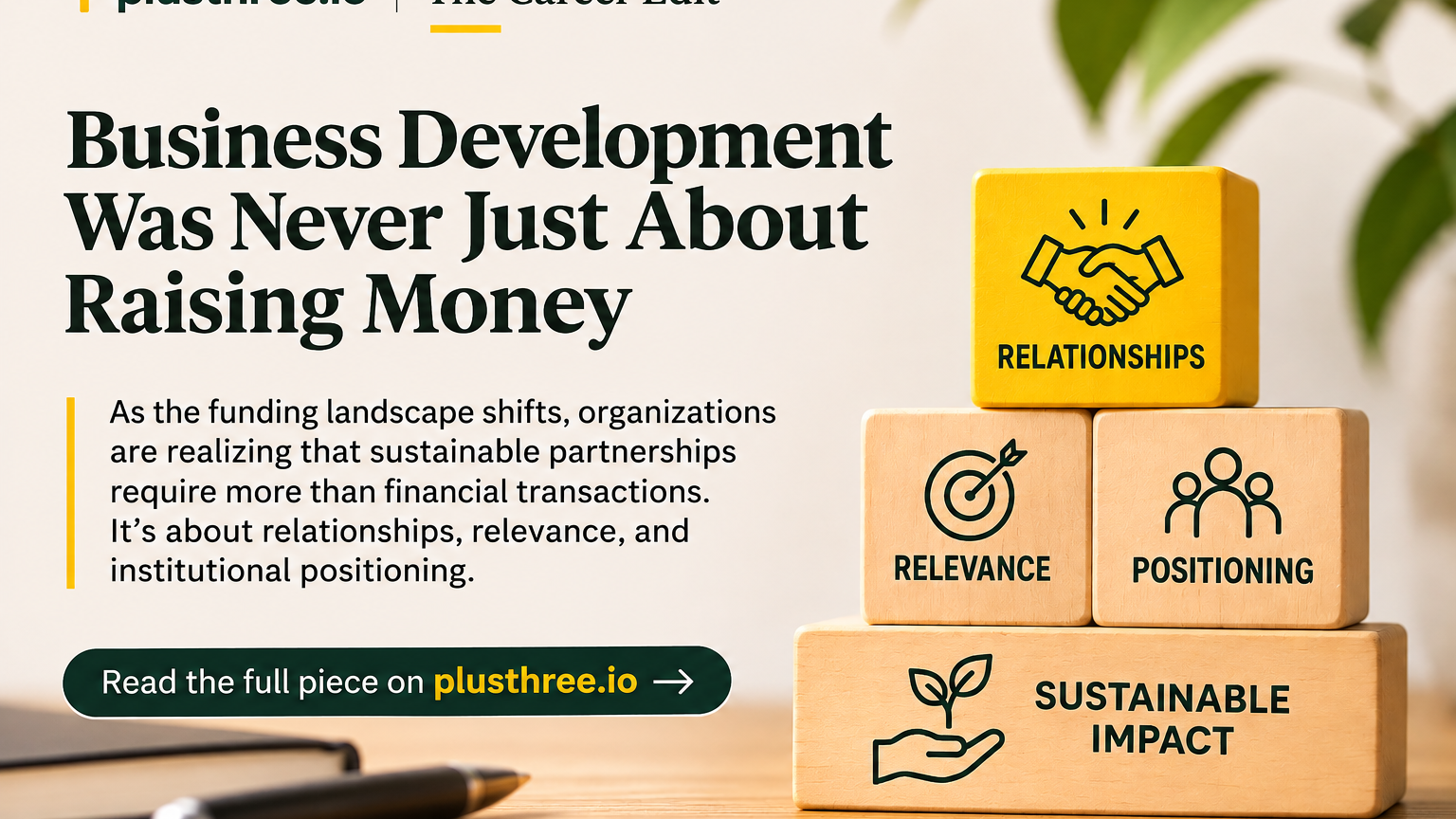
The challenge was never just about raising money. It was about how organizations understood and managed relationships.
For a long time, many social impact organizations operated under a funding model in which donor priorities significantly influenced program design. Rather than consistently asking how funding could advance their organizational mission, some organizations adapted their programs to fit available funding opportunities. Over time, this created portfolios that were responsive to donors but not necessarily anchored in a coherent long-term organizational strategy.
When the funding landscape began to shift, the vulnerabilities became apparent. Organizations heavily dependent on a small number of restricted grants struggled to adapt. Some significantly reduced operations, while others closed altogether. It wasn't necessarily because their work had become irrelevant, but because their operating and funding models had limited room to evolve.
This is why I find the growing prominence of Communications, Partnerships, Strategic Engagement, and External Affairs roles across the sector particularly interesting.
I see it as a recognition that relationships cannot be managed solely through financial transactions, quarterly reports, or biannual donor updates.
A funding partner should understand an organization beyond the project they are financing. They should understand its mission, the systems it is helping to strengthen, the evidence it is generating, the relationships it has built, and the long-term change it is working toward.
Equally, organizations must demonstrate value beyond the funding they receive. What knowledge are they contributing to the sector? What conversations are they influencing? What partnerships are they building? What makes their work relevant to governments, communities, peer organizations, and potential collaborators?
These questions require a different approach to business development.
It means investing in relationships even when there is no immediate funding opportunity. It means bringing communications into strategic conversations rather than treating it as a function that documents activities and publishes success stories. It means positioning organizational leadership to participate meaningfully in sector conversations, policy discussions, and networks where future partnerships are often formed.
It also means recognizing that business development is not the sole responsibility of the person carrying the fundraising target. Program teams generate evidence and technical credibility. Communications translates that evidence into compelling narratives. Leadership builds institutional trust and strategic relationships. Finance and operations demonstrate the organization's ability to deliver responsibly. Together, these functions contribute to an organization's ability to attract and sustain partnerships.
I would argue that the organizations best positioned for the next chapter of the social impact sector will not necessarily be those with the largest fundraising teams. They will be those that have built the strongest institutional relationships, the clearest organizational identity, and the ability to articulate their value beyond individual projects.
This does not mean fundraising is becoming less important. Quite the opposite. It means fundraising must become part of a broader institutional strategy rather than the strategy itself.
Perhaps the question for social impact leaders today is no longer simply, "How much funding can our business development team raise?" but rather, "How well have we positioned our organization to remain relevant, trusted, and valuable, even when funding priorities change?"
Because ultimately, funding may sustain a program, but relationships, relevance, and a clear sense of purpose are what help sustain an institution.