
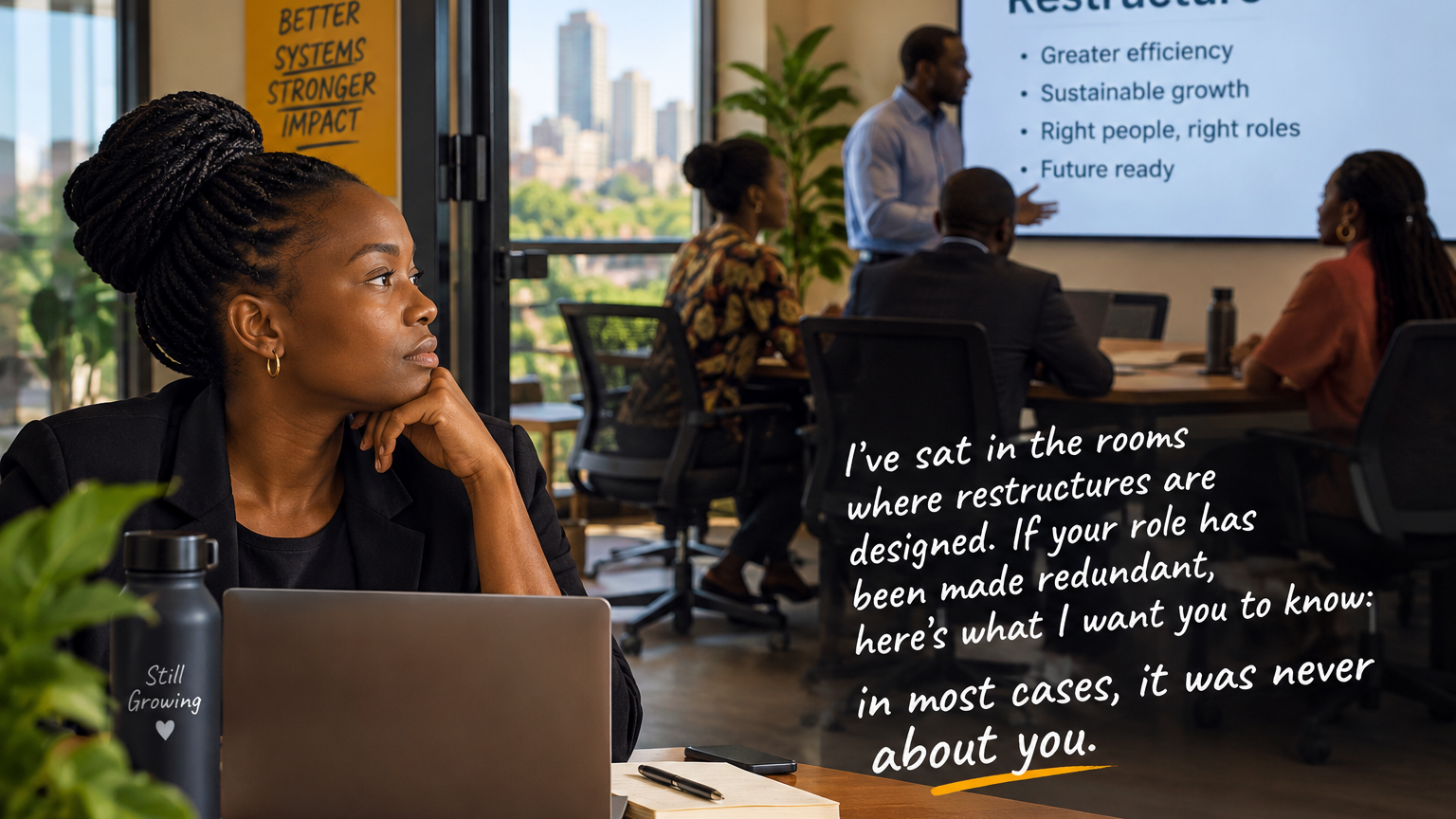
"Your role has been made redundant."
These words have become all too familiar in the social impact and employment space. Yet no matter how familiar they are, they still bring so much hurt: feelings of betrayal, unworthiness and inadequacy. Sometimes even shame. And somewhere between that conversation and the drive home, one question takes over: What did I do wrong?
I have found myself on the other side of that table many times. I have been in the rooms where restructures are designed, where organization charts are redrawn and where hard choices are made. And what I want you to know is this: in most cases, it was never about you.
The view from the room
Organizations restructure for a handful of reasons. Funding shifts. The mission changes. Or the organization needs to become more agile to survive what is coming. Whatever the trigger, the question on the table is the same: what structure does this organization need to deliver its mission with the resources it has?
Notice what that question is about. Structure. Not people.
In these meetings, leaders are encouraged to focus on the positions critical to the mission, not the people who are critical to the mission. The conversation is about functions, reporting lines, budgets, and where the work is going next. A role can be eliminated because the program it served has ended, because two functions are being merged, or because the organization can no longer afford a layer it once could.
None of those decisions is a verdict on the person in the role. It is a re-structure, after all.
This is also why the outcome can feel so unfair. You may have watched strong performers leave while others you considered less effective stayed. The structure is deciding, not the organization saying one person is better than another.
What happens in that room also shapes how, and when, you hear the news. Some organizations are too opaque and guarded about anticipated changes, often because they do not want to cause anxiety, which ultimately affects performance. In my experience, early notice does bring anxiety at first, but continual communication as the changes take effect usually helps teams process them better. That said, once the outcome is final, news of redundancy never lands easily, even with a well-prepared team.
How the choice gets applied
Once the new structure is clear, the organization has to decide how to apply it. The most common approaches are:
Last in, first out. The most recent hires in an affected role leave first. It is simple and easy to defend. It has nothing to do with your contribution.
Suitability interviews. Where new or reshaped roles exist, staff are assessed for fit. Not being selected means your profile matched the new role less closely than someone else's. It does not erase what you brought to the old one.
Selection criteria. Some organizations score affected staff against set criteria. In Kenya, for example, the Employment Act requires employers to consider seniority as well as skill, ability, and reliability when selecting who is affected.
Voluntary separation. Some organizations offer packages first, so people can choose to leave on their own terms.
Each method has its strengths and its blind spots. But they all start from the same place: the role, the criteria, the structure. Not a feeling about you.
When it is personal
I would be doing you a disservice if I said it is NEVER personal. Sometimes a restructure is used to remove someone the organization did not want to manage through an honest performance conversation. That is a failure of leadership, and it happens.
How do you tell the difference? Look at the pattern. Was a whole function or level affected, or only you? Were the criteria shared and applied consistently? Was the role eliminated, or quietly refilled a few months later under a new title? If the answers point to you alone, you have every right to ask questions and, where needed, to seek advice on your rights.
And even when it is not personal, it can still be handled badly. Silence until the last minute, rushed timelines, and a lack of care in how the news is delivered are real, and your frustration is valid. "Not personal" doesn't mean painless, and it doesn't mean done well.
Why this matters for you
So why does it matter whether you believe it was about you?
Because the story you tell yourself shapes what you do next. If you walk away believing you failed, you carry that into every application, every interview, and every first day. You undersell yourself. You hesitate to go for the bigger role. You walk into the next opportunity braced for the same thing to happen again.
When you understand that a structure changed, not your value, you can grieve what you lost without letting it define you. And then you can move.
Yes, you are hurt by the choices that were made. That hurt is real, and it deserves room. But the sooner you separate the decision from your worth, the faster you will pivot to your next role and step into it with confidence.
What to do next
Ask about the criteria. You are entitled to understand how the decision was made. Clarity helps you process it and shows whether the process was fair.
Negotiate your exit. Timing, package, references, and how your departure is communicated are often more flexible than they first appear. Ask.
Secure your references early. While goodwill is high, ask your manager and colleagues for references and recommendations.
Practice your one-line story. "My role was eliminated as part of a restructure" is a complete, credible answer in an interview. You do not need to defend it.
Take time to grieve. Pivoting fast does not mean skipping the feelings. Rest, talk to people you trust, and let yourself feel it before you sprint.
Take stock of what you built. Write down what you delivered, what you learned, and what you want next. That list becomes the raw material for your next role.
It was never about you
I have seen how much it hurts when a role ends, and I know how those decisions are made. If you take one thing from this, let it be this: the structure changed, not your worth. You did not become less capable, less valuable, or less ready, and there is nothing to be ashamed of.
It was never about you. Now go get ready for the next big thing coming your way.
Have you been through a redundancy? What helped you move forward? Hit reply and tell me. I read every message.