On the people who take a chance on us, the opportunities that shape our careers, and why opening doors for others matters.
I am deeply conscious of the fact that I have been able to occupy the professional spaces I do because someone, somewhere, chose to take a chance on me. It wasn't necessarily because I was the most qualified person in the room or because I possessed a flawless CV. Someone saw an opportunity to give me a shot. I can trace my most defining professional milestones directly to individuals who chose to let me in.
My first experience in a professional setting came through a leadership development internship at a faith-based institution. The opportunity materialized through a friend of my brother’s. He didn’t know me personally, but he knew my brother had a sister who needed a space to gain practical experience.
It wasn't a paying job, and there was no promise of permanent employment at the end of it. It was a canvas to learn, to understand the dynamics of a workspace, to develop professional discipline, and to discover what I was capable of contributing. I showed up, absorbed everything I could, and did my absolute best with whatever task was placed in front of me.
What I didn't know then was that this seemingly small open door would lay the foundation for my entire career in the NGO sector—or what we now more broadly call the social impact sector.
Sometimes, an opportunity arrives disguised as something else
As part of that leadership development programme, we were required to raise financial support from well-wishers who believed in our growth and were willing to invest in our development. During this tracking process, I approached a personal acquaintance to ask if she would consider supporting me financially.
Instead of writing a check, she offered me a job.
She saw an immediate need in her own work and brought me on as her personal assistant at a public health NGO. I often think about how differently that conversation could have gone. She could have handed me a small financial contribution, wished me the best, and we both would have moved on. Instead, she recognized a deeper need than the one I had presented. I was looking for short-term funding; she saw that an employment opportunity would offer something far more sustainable.
That single move became my official entry point into the NGO sector.
It wasn’t a meticulously mapped-out career strategy. I didn't have a grand 10- or 15-year plan. I recognized that someone had handed me a rare key, and I had a distinct responsibility to build something meaningful with it.
An open door is an access point, not a guarantee
These early experiences have continually shaped how I view professional networks and career progression. I understand the privilege of connection. I know what it means for someone to speak your name in a room you haven't yet entered, to make a warm introduction, or to validate your potential before you’ve had the conventional track record to prove it.
I have also learned an equally vital truth: the person who opens the door for you is not responsible for how far you walk once you cross the threshold.
When someone grants you access, gratitude is only the first step; intentionality must follow. You must study the environment. Understand the core work. Build standalone relationships that exist independently of the person who introduced you. Refine your skills, ask sharp questions, take calculated initiative, and find ways to deliver undeniable value.
Avoid becoming overly dependent on your original champion. Their role was to create access; your role is to convert that access into impact.
Sometimes, maximizing an opportunity means embracing a trajectory you never anticipated. Neither of the first two roles was part of a deliberate plan, yet both became foundational stepping stones. That is the beauty of a career—we often speak about it as a predictable, linear path, but reality shows us that the most significant turning points are sparked by unexpected conversations and relationships.
If we acknowledge that professional connections accelerate our success, we must also accept the responsibility to create that same access for others. Talent and ambition are distributed evenly across the world, but access to information and opportunity is not; not everyone has a well-connected network, an unexpected champion, or an entry point into exclusive professional circles.
This is the heartbeat behind PlusThree.io, a platform built to eliminate information asymmetry by making high-impact opportunities visible across Africa. Too many consultancies, grants, fellowships, and remote social impact roles remain siloed inside closed networks or buried across fragmented global boards. PlusThree.io centralizes this landscape, bringing these hidden pathways straight to professionals across the continent who want to do meaningful work.
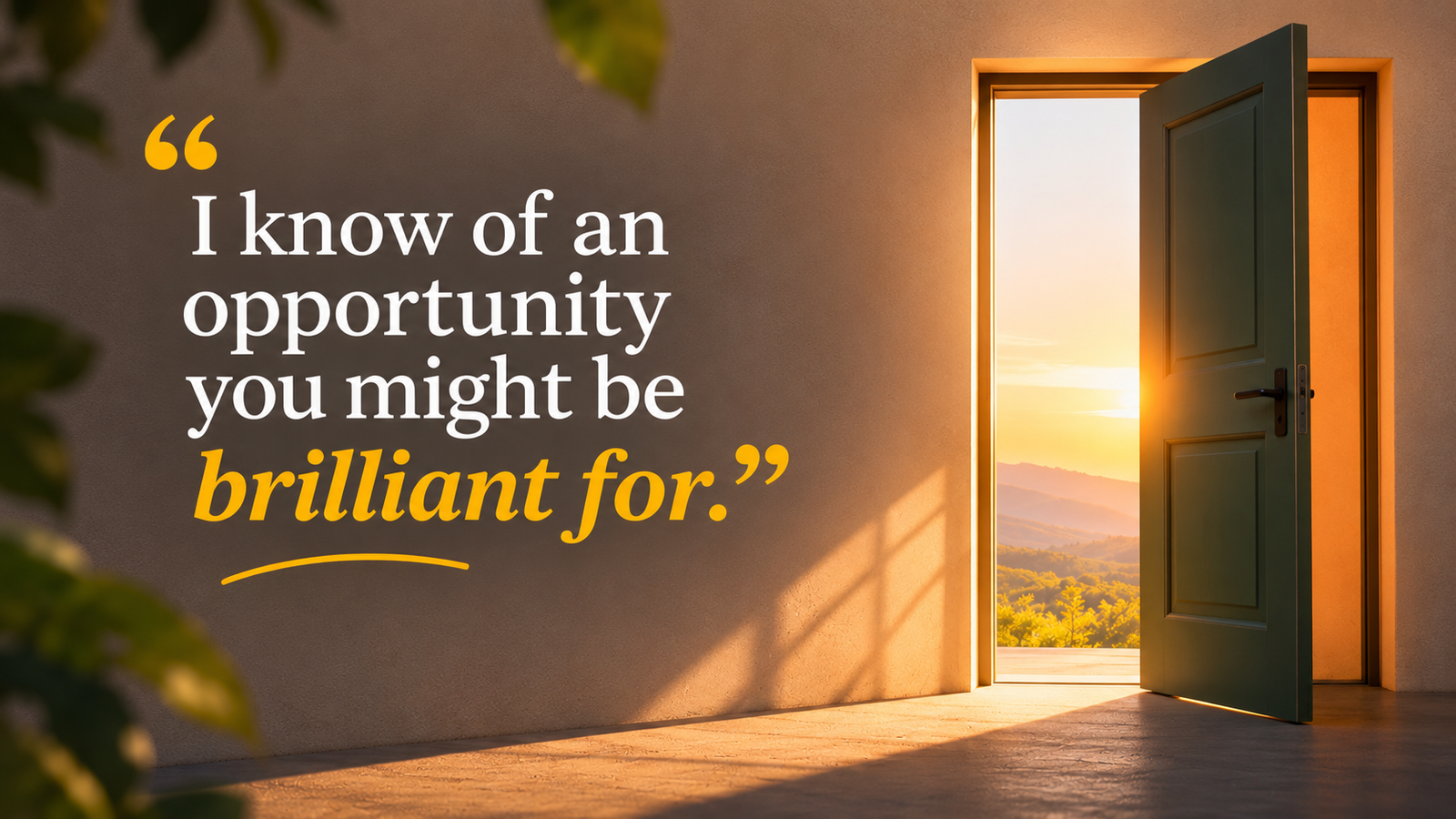
While I cannot guarantee a successful shortlist or promise an offer letter, I can make the opportunity visible so that your talent has a target. My role is simply to help unlock the door; how you prepare, articulate your value, and follow through is entirely your journey to own—and perhaps, down the line, you will find yourself standing on the other side, ready to say to someone else: "I know of an opportunity you might be brilliant for."